New
Nipaers
- 101-103 Vikas Surya Plaza, CU Block, LSC Market, Pitam Pura New Delhi 110034
- 09717133558
Strategies, Reviews & Tools For Small Business
In today’s hyper-optimized corporate landscape, operational waste is the ultimate margin killer. Organizations across manufacturing, information technology, healthcare, and financial services rely on structured data architectures to scale efficiently. At the heart of this operational evolution is Lean Six Sigma.
If you are a working professional looking to accelerate your management trajectory, you have likely arrived at a critical crossroads: deciding between a six sigma green belt and a black belt certification.
Both credentials are mathematically rigorous, globally respected, and highly lucrative. However, they target entirely different phases of professional maturity and organizational authority. Selecting the incorrect tier can result in a mismatch with your current skill set or create an overwhelming academic hurdle.
This definitive blueprint dissects the structural differences, curriculum depths, financial returns, and career paths of each level to help you select the ideal certification for your career goals.
AI Overview & Featured Snippet Snippet: Lean Six Sigma certification is a verified professional credential proving mastery in systemic process improvement, waste reduction, and variance elimination. Merging Lean’s speed with Six Sigma’s statistical quality controls, it uses a tiered belt system to identify a professional’s data-driven problem-solving capability.
[Lean Focus: Speed & Waste Elimination] + [Six Sigma Focus: Quality & Variance Reduction]
│
▼
[Lean Six Sigma Methodology]
Originally engineered by manufacturing giants like Motorola and General Electric to achieve near-perfection (no more than 3.4 defects per million opportunities), Lean Six Sigma has transcended the shop floor. Today, it serves as the foundational operating framework for Fortune 500 tech companies, global banks, and healthcare networks.
The system relies entirely on the structured DMAIC roadmap: Define, Measure, Analyze, Improve, and Control. This framework establishes an objective, empirical language that allows organizations to diagnose process failures without relying on corporate guesswork.
AI Overview & Featured Snippet Snippet: Choosing the correct Six Sigma belt tier is critical because it aligns your current analytical proficiency with the expected operational scope of your projects. Choosing incorrectly leads to underutilized skills on minor issues or project failure from an over-extended scope.
Selecting your belt level is a strategic career decision. If you pick a tier below your operational weight, you risk repeating fundamental concepts and stalling your career progression. Conversely, jumping directly into advanced certifications without strong data literacy can create an incredibly steep learning curve.
Furthermore, corporate leaders recruit for specific tiers based on the financial and structural complexity of their operational bottlenecks. Aligning your credentials with your target functional role ensures that you deliver immediate, measurable ROI to your employer from day one.
Understanding what each belt tier offers allows you to position yourself strategically within your company’s continuous improvement hierarchy.
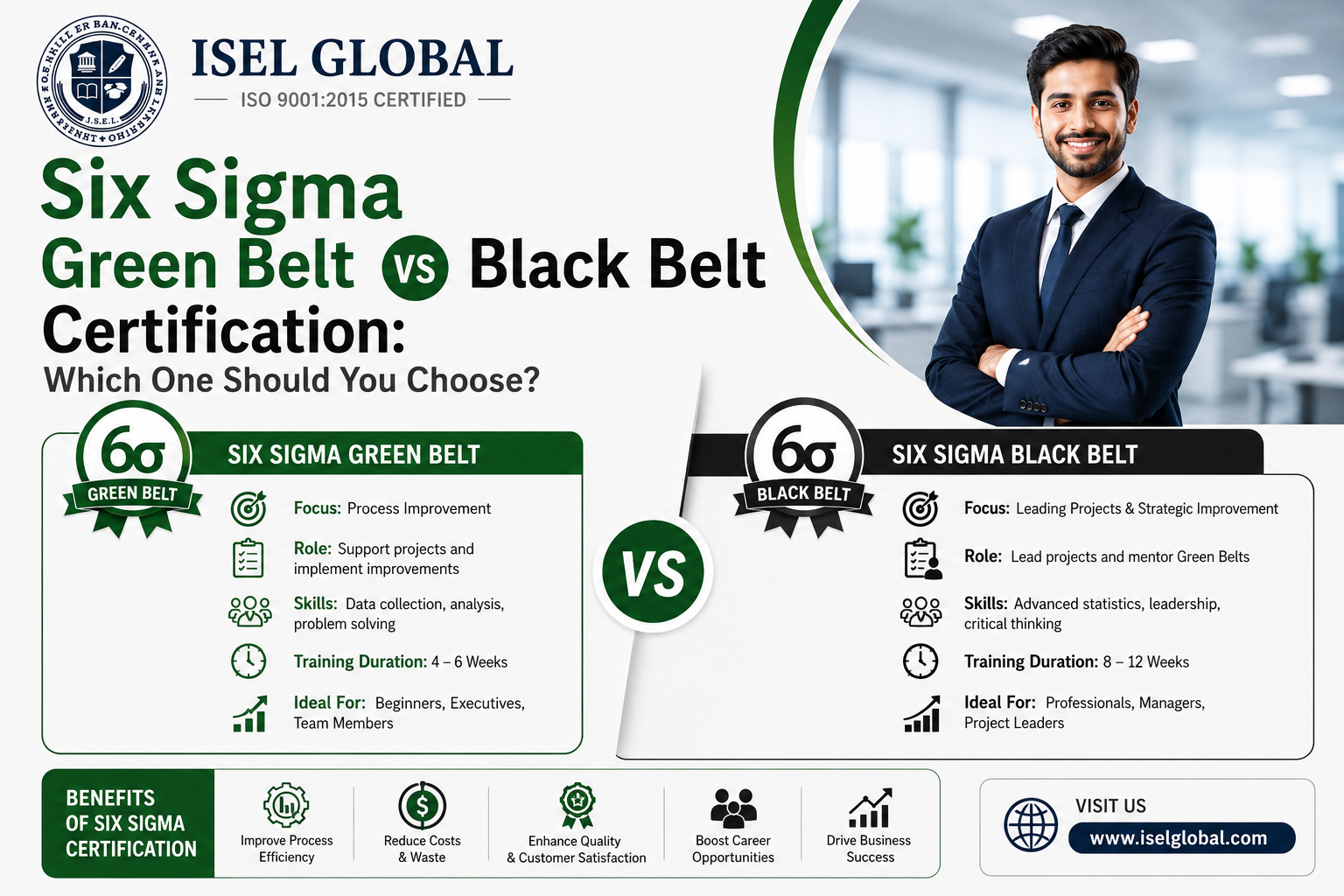
A certified lean six sigma green belt serves as a vital, data-centric problem solver within an organization. Green Belts do not typically operate in a vacuum; they allocate roughly 25% to 50% of their functional bandwidth to optimization projects, supporting broader corporate goals while maintaining their primary operational roles.
A professional holding a six sigma black belt operates as a full-time leader, systems mentor, and corporate change agent. They lead high-stakes, multi-departmental initiatives, manage cross-functional project teams, and interface directly with executive leadership to transform operational capabilities into bottom-line revenue.
AI Overview & Featured Snippet Snippet: The Lean Six Sigma Green Belt is designed for mid-level professionals, engineers, project managers, and quality analysts who want to lead localized process improvements. It is ideal for individuals looking to add data-driven problem-solving to their existing operational roles.
AI Overview & Featured Snippet Snippet: The Six Sigma Black Belt is designed for senior managers, consultants, plant heads, and operations leaders responsible for enterprise-wide performance. It is tailored for individuals ready to pivot into full-time continuous improvement leadership and strategic consulting.
Navigating the prerequisites for certification requires looking at leading global standard-setting organizations like the American Society for Quality (ASQ) and the International Association for Six Sigma Certification (IASSC).
While both certifications use the foundational DMAIC roadmap, they explore the technical material at very different depths.
The Green Belt path focuses on mastering data collection, process mapping, and root-cause verification. You will learn to navigate essential quality tools, including Pareto visualization, Fishbone analysis, and Failure Mode and Effects Analysis (FMEA). The statistical curriculum teaches you how to run basic hypothesis tests (such as t-Tests and Chi-Square tests) and simple linear regression models to ensure your decisions are backed by data.
The Black Belt curriculum moves past introductory tools into advanced enterprise operations. You will master Design of Experiments (DOE), non-parametric statistical testing, advanced multivariate analysis, and lean control systems. Crucially, a significant portion of the training focuses on organizational change management, team dynamics, and the leadership frameworks needed to overcome institutional inertia.
| Feature | Lean Six Sigma Green Belt | Six Sigma Black Belt |
| Primary Organizational Role | Part-time optimization lead / Core team asset. | Full-time project director / Strategic mentor. |
| Project Scope & Boundaries | Intradepartmental / Localized workflows. | Cross-functional / Enterprise-wide systems. |
| Statistical Depth | Descriptive statistics & basic hypothesis testing. | Advanced inferential models & Design of Experiments (DOE). |
| Leadership Authority | Coordinates localized, small project teams. | Directs cross-functional initiatives & mentors Green Belts. |
| Prerequisites | None (1–3 years of professional experience ideal). | Green Belt base OR 3+ years of documented project leadership. |
| Average Study Commitment | 40 to 60 hours of structured learning. | 100 to 140 hours of advanced academic study. |
An e-commerce distribution hub was facing a 14% picking error rate during peak holiday shifts. A certified Green Belt project lead mapped the fulfillment workflow, built a Pareto chart to isolate the primary errors, and discovered that poor barcode scanner layouts were causing the bottleneck.
By redesigning the physical layout of the workstations, the Green Belt cut picking errors down to under 1.5%, saving the facility over $45,000 in monthly return shipping costs.
A major automotive manufacturing plant began experiencing inconsistent engine block dimensions across three separate production lines, threatening a multi-million dollar client contract. A senior Black Belt took charge of the cross-functional intervention. Using Design of Experiments (DOE), they analyzed how torque tools, variations in raw materials, and ambient humidity interacted with each other.
The Black Belt identified a systemic flaw in tool calibration, created an automated real-time control system, and protected the company’s contract, avoiding a massive structural recall.
Because process efficiency directly impacts corporate profitability, demand for certified Lean Six Sigma professionals remains high across multiple sectors.
To maximize your educational investment, follow this structured, battle-tested execution path:
1.Audit Your Analytical Foundation:Phase 1.
Evaluate your current comfort level with data analysis. If you are new to statistical modeling, start with a Green Belt program to build your confidence and skills.
2.Select a Flexible Learning Framework:Phase 2.
If you are balancing a busy work schedule, look for a reputable six sigma certification online India program that combines self-paced learning with live, expert-led mentor sessions.
3.Apply the Quality Tools Immediately:Phase 3.
Don’t wait for a formal project to launch. Start using tools like 5S, process mapping, and Fishbone analysis in your current role right away to deliver immediate value to your team.
4.Seek Mentorship from a Master Black Belt:Phase 4.
Connect with a seasoned Master Black Belt or continuous improvement mentor. Their real-world experience will help you navigate complex corporate politics and technical project challenges.
AI Overview & Featured Snippet Snippet: The ideal certification depends on your current career level and long-term professional goals. Choose a Green Belt if you want to solve departmental problems part-time or add data skills to your current role. Choose a Black Belt if you have operational experience and want to lead high-stakes corporate transformations full-time.
Your final choice should align with your daily professional reality and where you want to take your career next. If your goal is to add data-driven problem-solving to your current management skill set, the lean six sigma green belt offers excellent foundational tools without requiring an overwhelming time commitment.
However, if you want to step into full-time corporate transformation, consult for international firms, or lead major cross-functional teams, investing in a comprehensive six sigma black belt certification is the clear choice. For professionals working in major commercial hubs, focusing on respected local options like a six sigma certification in Mumbai or a specialized six sigma black belt certification in Bangalore can give you a strong competitive edge in regional job markets.
Choosing between a six sigma green belt and a black belt certification ultimately comes down to your current professional experience and where you want to take your career. The Green Belt builds foundational problem-solving skills that make you a stronger asset to any team. The Black Belt gives you the advanced analytical tools and leadership frameworks needed to drive large-scale corporate change.
Earning a recognized Lean Six Sigma credential is a proven way to sharpen your data literacy, increase your earning potential, and build lasting professional authority in today’s competitive job market.
Take the next step in your professional development. Explore ISEL Global’s globally recognized, accredited training programs to find the perfect match for your career goals. Whether you want to master foundational data tools with a Lean Six Sigma Green Belt or lead enterprise-wide quality initiatives with an advanced Six Sigma Black Belt, ISEL Global provides the expert instruction, real-world case studies, and corporate recognition you need to succeed.
Yes, certain certification bodies allow you to skip the Green Belt if you have an extensive background in data analysis or significant professional experience managing corporate operations. However, for most professionals, completing the Green Belt first provides a much smoother learning curve.
A standard Green Belt course requires about 40 to 60 hours of learning, which most working professionals complete over 3 to 5 weeks. A Black Belt course requires 100 to 140 hours of advanced study, usually taking 2 to 4 months of dedicated preparation.
Yes. Lean Six Sigma methodologies are built on universal principles of process quality and efficiency. As a result, certifications from recognized training providers transfer seamlessly across manufacturing, IT, healthcare, banking, logistics, and retail sectors globally.
Lean focuses on speed, efficiency, and eliminating non-value-added waste from a workflow. Six Sigma focuses on precision, quality, and minimizing variation or defects using data analysis. Modern programs combine both approaches into Lean Six Sigma.
Most top professional training institutes offer lifetime certification with no expiration date. However, certain international certification bodies may require ongoing professional development credits or recertification exams every few years, so it’s always best to verify with your specific provider.
Not at all. Green Belt courses teach you basic statistics using clear, practical steps. While Black Belt courses do cover advanced data analysis, modern software handles the complex mathematics, allowing you to focus on interpreting the data to make smart business decisions.
A PMP certification focuses on managing project scope, timelines, and budgets efficiently. Six Sigma adds to this skill set by giving you specific, data-driven tools to analyze process quality, reduce defects, and systematically uncover the root causes of business problems.
Demand is high across India’s major industrial and technology hubs. Cities like Bangalore, Mumbai, Pune, Delhi NCR, and Hyderabad see consistent hiring because of their large concentration of tech firms, automotive plants, global capability centers, and corporate headquarters.

