New
Lean Six Sigma Black Belt Certification: Advanced Skills and Career Opportunities
- Ground floor A, 130, A Block, Sector 63, Noida, Uttar Pradesh 201309
- 09582676175
Strategies, Reviews & Tools For Small Business
Imagine you’ve just finished a digital marketing course. Certificate in hand, feeling decent about yourself. Then your first client says, “can you set up a Google Ads campaign by next week?” And your stomach drops a bit.
That’s the gap, really. Knowing about SEO tasks, ad campaigns and social media accounts is one thing. Doing them for an actual business without panicking is another. Which is exactly why the Best Digital marketing course in Lucknow with practical training, an internship and job assistance matters in 2026. I’d argue it’s the part most people skip.
What should a good Digital marketing course in Lucknow actually do? Teach you how businesses get customers online, sure. But also push you through the real activities, and leave you ready for the duties of an entry-level job. The internship bit is where you get assignments and see how a professional workflow runs. Job assistance helps with interview prep and with finding openings that fit.
Whether you’re a student, a job seeker, already working, or you own a business in Lucknow, this guide goes through what to check before you join, and what internship and placement support can (and can’t) do for you.
I’d say yes, mostly. Practical training and an internship help you link what you learned in class to real workplace tasks, and you pick up some experience with SEO, Google Ads, social media and reporting along the way. But no, an internship or job assistance doesn’t guarantee a job. That depends on your skills, how you perform, eligibility, and what openings exist.
A digital marketing course teaches you to promote businesses, products and services online. SEO, paid ads, social media, content, email campaigns, analytics, roughly that list.
Add an internship and there’s practical exposure too. Depending on the programme you might do supervised assignments, work on actual marketing tasks, or at least watch how digital campaigns get managed.
Job assistance is the career-side support an institute offers. Resume guidance, interview preparation, portfolio help, info about openings.
I’d keep these five apart in your head, since people blur them. Training: learning concepts and tools. Practical projects: using them on sample or real business tasks. Internship: structured work exposure under set conditions. Job assistance: guidance while you search. Employment: an employer picks you through its own hiring process.
Linked stages, yes. Same thing, no. A responsible institute tells you what it offers at each one.
Tools and platforms keep shifting. Businesses use Google, Meta, YouTube, LinkedIn and a bunch of others to reach customers, and AI tools like ChatGPT and Gemini are changing how research, content planning and workflows happen.
For a beginner, theory by itself rarely cuts it. Employers like people who can say what they’ve worked on and how they’d tackle a regular marketing task.
So why do practical training and an internship help? A few reasons.
You see how marketing work happens. Take a local educational institute that wants more student enquiries. The marketer might research keywords, improve course pages, write social media content, plan a Google Ads campaign. Do that once, even on a sample, and you start seeing how the channels support one business goal.
You build practical skills. Depending on the internship structure and what you’re assigned, you may practise keyword research and SEO analysis, website content optimisation, social media content planning, Google Ads campaign basics, Meta advertising fundamentals, lead generation activities, website and campaign reporting, and marketing research including competitor analysis.
You get a portfolio. Writing “I know SEO” on a resume tells nobody anything. Walking through a keyword research exercise, a website audit or a content optimisation project tells them a lot. Just get permission before you publish confidential business data, client information or campaign screenshots.
Interviews get easier. Somebody asks how you chose keywords, planned a campaign or measured website performance, and instead of freezing you have an actual answer. Explaining your approach usually beats reciting definitions.
A comprehensive course covers the major channels and how they fit together.
SEO helps websites show up better in organic search results. Look for keyword research and search intent, on-page SEO, technical SEO fundamentals, off-page SEO, internal linking, local SEO, website audits and search performance analysis.
Say a business in Gomti Nagar wants its website to appear when people search for its services in Lucknow. Local SEO improves the site’s relevance and visibility for those location-based searches.
Google Ads lets businesses run paid campaigns across Google’s advertising network. PPC means Pay-Per-Click, a common model where advertisers pay when people click the ad. You’d want to understand campaign objectives, keyword selection, ad copy, budgets, bidding, conversion tracking and optimisation.
A decent practical exercise: plan a sample search campaign for a local service business, then work out which keywords and which landing page it needs.
Social Media Marketing helps businesses talk to audiences on Instagram, Facebook, YouTube and LinkedIn. Topics may include social media strategy, content calendars, reels and post planning, audience research, Meta Ads basics, engagement analysis and reporting.
SMO, Social Media Optimization, is about improving social profiles and content so a brand gets more visibility and engagement.
Content marketing is creating useful content for a target audience. You might practise writing blogs, website pages, captions, video scripts and other marketing material, and you should get a feel for search intent, content structure, fact-checking and editing.
Email marketing helps businesses stay in touch with subscribers and customers: campaign planning, email content, audience segmentation, basic automation and performance measurement.
Digital marketers need to know whether their work is producing anything useful. Training may cover website traffic, user behaviour, lead tracking, conversions and campaign reports. Google Analytics concepts help you see how people use a website.
ChatGPT and Gemini can help with research, brainstorming, content planning and productivity. Learn to review what AI gives you, check accuracy and add your own insights. AI should support marketing decisions. It shouldn’t replace human judgement.
An internship lets you see how marketing tasks get done in a working environment. It varies between institutes and employers, so confirm the exact terms before you enrol.
A typical path: you finish the required training and practise the main tools. You do assignments, SEO or social media or content or advertising exercises. You learn the workplace basics, like taking instructions, meeting deadlines, preparing reports. You get practical exposure to assigned activities under whatever supervision and internship conditions apply. You collect feedback and spot what needs work. And you organise suitable project examples into a portfolio.
For instance, you might be asked to prepare a keyword list for a local business, suggest improvements to a website page and create a monthly social media content calendar. Small tasks, but they show how concepts work in practice.
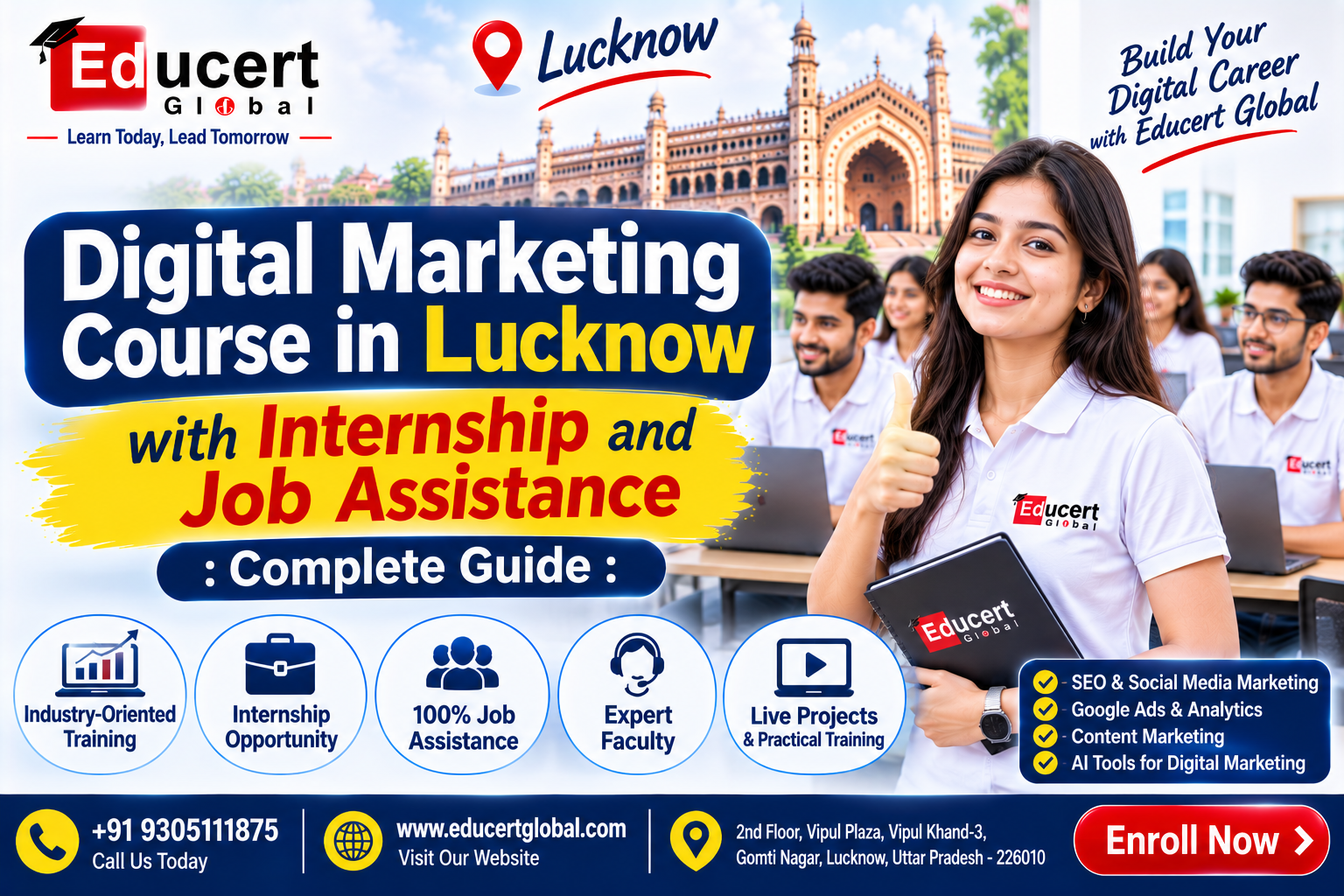
Educert Global offers digital marketing training with practical learning, and advertises a three-month paid internship opportunity.
That can matter if you want to understand marketing tasks beyond classroom sessions. Still, availability, selection, eligibility, payment terms, responsibilities and duration should be confirmed directly with the institute before admission.
Some questions worth asking before you join. Is the internship open to every learner, or based on selection? How long is it? What tasks will interns complete? Is it paid, and what are the payment conditions? Will you get supervision and feedback? Will there be an internship completion certificate, and under what conditions?
Clear answers tell you what the opportunity includes, and save you confusion later.
Beginners often don’t know how to present their skills or prepare for digital marketing interviews. That’s where job assistance helps. A structured process may include the following.
Describe your training, skills, assignments, tools and project experience clearly. And don’t list tools you’ve never touched.
A portfolio can hold approved examples of SEO research, content plans, website audits, social media calendars or campaign exercises.
Practise explaining digital marketing concepts and how you approach practical tasks, out loud if you can.
Institutes may share relevant openings or point you to suitable entry-level roles, depending on their process and the opportunities available.
One more time, because it matters: job assistance isn’t a guarantee of placement. Employers make their own decisions based on requirements, interviews and candidate performance.
Pretty much anyone, to be honest. You usually don’t need advanced coding knowledge to start with the fundamentals.
Students can build practical skills next to their education and look at entry-level career options. Freshers can learn SEO, paid advertising, content marketing and social media management, and practical projects give them something to show in interviews. Working professionals may learn digital marketing to upgrade their skills, take on extra responsibilities or switch careers. Business owners learn how to promote their products and services online, generate leads and measure campaign performance. Freelancers can develop service-based skills and slowly build a portfolio.
Duration and fees depend on the programme level, number of modules, training hours, practical sessions and learning format. Educert Global offers different paths.
About 2 months offline, about 2.5 months online. 12 modules, 64 training hours.
About 3.5 months offline, about 4 months online. 17 modules, 112 training hours.
About 5.5 months offline, about 6 months online. 32 modules, 176 training hours. The professional option covers a wider range of subjects and gives you more training hours.
Digital marketing course fees in Lucknow vary with the institute, course level, syllabus, training hours and practical facilities. Before paying, check whether the fee includes the full course training, practical assignments and projects, study materials, certification details, internship eligibility and conditions, placement assistance, and any extra tool or examination costs.
Educert Global’s current fees should be confirmed directly with the institute, because prices and offers change. Visit the Digital marketing course in Lucknow page to review the programmes and ask for current details.
Certifications can support your profile by showing you’ve completed a course or passed a platform assessment. Depending on the platform and eligibility requirements, you may look at certifications related to Google Ads, analytics and Meta advertising.
But a certificate alone doesn’t show that you can manage a campaign or improve a website. Employers may also look at practical ability, communication, problem-solving and project experience.
What works best is a mix: relevant training, practical assignments, recognised certifications where they apply, a portfolio of your work, and interview preparation.
Once you’ve finished training and built practical skills, you can explore several career paths.
An SEO Executive works on keyword research, website optimisation and organic search performance. A Digital Marketing Executive supports several online marketing activities. A Social Media Executive plans content and manages social media accounts. A Google Ads Executive helps manage paid search campaigns, and a PPC Executive works on paid advertising and campaign performance. A Content Marketing Executive creates and manages marketing content. A Digital Marketing Analyst studies campaign and website data. And a Freelance Digital Marketer provides digital marketing services to clients.
The right role depends on your interests, practical knowledge and experience.
Salaries in Lucknow vary with experience, skills, job responsibilities, company size and how you do in interviews. Freshers usually apply for entry-level roles, while experienced professionals may move into specialist, analyst or managerial positions.
For better career preparation, work on strong SEO or advertising fundamentals, learn to interpret campaign data, build a portfolio, improve your communication skills, understand business goals, and practise interview questions.
And please don’t choose a course based only on advertised salary claims. No training programme can guarantee a particular salary for every learner.
Both work. The right format depends on your schedule, location and how you learn.
Offline classes let you interact directly with trainers, ask questions and join classroom discussions. They may suit you if you live near Gomti Nagar and like a structured classroom environment. If you’re searching for the best offline digital marketing course in lucknow, compare training hours, practical work, trainer support and the syllabus.
Online classes give flexibility to working professionals and to students who can’t travel regularly. If you’re comparing the best online digital marketing course in lucknow, check whether live sessions, assignments, feedback and doubt-clearing support are included.
The most effective option is the one that helps you show up consistently, finish projects and understand the subject.
Before enrolling, compare institutes on training quality and how open they are about the details.
Go through this. Read the complete syllabus. Ask about trainer experience and practical knowledge. Check the number of training hours. Understand how assignments and projects run. Confirm internship eligibility and payment conditions. Ask what job assistance actually includes. Check the online and offline batches available. And attend a demo class if you can.
Searching for the Best digital marketing institute in Lucknow? Don’t judge an institute by advertisements or promises alone.
Looking for the Best digital marketing training in Lucknow? Compare the learning experience, practical exposure, course structure and the support students get.
Educert Global provides digital marketing training for students, freshers, working professionals and business owners who want practical marketing skills. Its learning options include beginner, advanced and professional programmes covering SEO, Google Ads, social media marketing, content marketing, analytics and AI-related tools.
If you’re looking for a Digital marketing institute in Lucknow, you can review the course structure and talk through your learning goals with the institute.
Learners searching for the Best Digital Marketing Institute in Gomti Nagar can also visit the training centre to see the classroom environment and the programmes available.
Educert Global contact details:
Address: 2nd Floor, Vipul Plaza, Vipul Khand-3, Gomti Nagar, Lucknow, Uttar Pradesh – 226010
Phone: +91 9305111875
Email: contact@educertglobal.com
Website: https://educertglobal.com/
Explore the Best digital marketing course in Lucknow to review course options, or contact the team for current batch and internship information.
Digital marketing keeps changing as search engines, social platforms, advertising tools and AI technologies develop.
A few areas worth knowing. AI-assisted marketing, using tools like ChatGPT and Gemini for research and content planning, with a human reviewing the output. Local SEO, helping businesses show up for relevant location-based searches. Video marketing, using YouTube and short-form videos to educate and engage audiences. Performance marketing, understanding campaign costs, leads and conversions. Marketing analytics, using data to make better decisions. And content strategy, creating useful content that answers customer questions.
For learners in Lucknow, each of these can be a direction for building skills. Long-term growth comes from continuous learning, practical experience and being able to adapt when platforms change.
A common beginner mistake is assuming that finishing a course automatically makes you job-ready. It doesn’t. Digital marketing takes practice, analysis and the ability to explain your decisions.
Take SEO. Learning it should mean more than memorising what keywords are. Practise researching search intent, reviewing a website page, improving its content structure and working out how to measure performance.
Same with Google Ads: campaign objectives, keyword selection, budget planning, ad relevance, conversion tracking.
An internship can give you useful exposure, but you have to take responsibility for asking questions, finishing assigned tasks and documenting your work. Those habits build confidence, and they make interview conversations a lot more meaningful.
The best one has a structured syllabus, practical assignments, experienced trainer guidance and clearly explained internship conditions. Compare training hours, subjects, project work, eligibility and career support before enrolling. Ask the institute what the internship involves instead of relying on promotional claims.
Not compulsory for every job, but practical exposure helps beginners. It can show you workplace tasks, deadlines, reporting and campaign activities. And a portfolio built through internships or well-documented projects helps you demonstrate skills in interviews.
Educert Global advertises a three-month paid internship opportunity. Confirm current availability, selection criteria, eligibility, payment terms, responsibilities and completion conditions directly with the institute. Asking before admission helps you understand the opportunity accurately.
No course can honestly guarantee that every learner will get a job. Institutes may offer placement assistance, resume guidance and interview preparation, but employers make the final selection. Your practical skills, communication, portfolio, performance and suitability for the role all influence the decision.
It depends on the programme level and training format. At Educert Global, the learning paths range from about two months for beginner offline training to six months for professional online training. Confirm the latest batch schedule and total training hours before admission.
Fees vary with the course level, syllabus, training hours and facilities. Internship arrangements may have their own eligibility and payment conditions. Ask the institute for a written fee breakdown, and confirm whether training, assignments, certification and internship-related activities are included.
Yes, they can apply for entry-level roles once they’ve built relevant skills. Understand basic SEO, social media, content and advertising concepts, and be ready to discuss your assignments or projects. A clear resume and portfolio help employers judge your practical knowledge.
Keyword research, SEO, content writing, social media management, Google Ads fundamentals, analytics and communication. Problem-solving, time management and the ability to understand business objectives count too. The exact skills depend on the role and the employer.
Yes, if they include structured lessons, live interaction, assignments and trainer feedback. You should also get chances to practise the tools and ask questions. Before enrolling, check the teaching format and what support is available between sessions.
Job assistance means the institute helps you prepare for employment through things like resume guidance, interview practice and job information. A placement guarantee would imply a specific employment commitment. Read the institute’s written terms carefully, and don’t assume assistance means guaranteed selection.
Yes. They can learn digital marketing to upgrade their skills or explore a career change. Online classes may offer scheduling flexibility, while offline classes give direct classroom interaction. Pick a programme whose timing and format you can manage consistently.
Certifications related to Google Ads, analytics and Meta advertising may support your profile, depending on each platform’s current requirements. They’re useful additions, but practical knowledge matters too. Combine certifications with project experience and the ability to explain your work.
Depending on your skills: SEO Executive, Digital Marketing Executive, Social Media Executive, PPC Executive, Google Ads Executive or Content Marketing Executive. Some learners work towards freelance services. The right option depends on your interests and practical experience.
Compare institutes in Gomti Nagar by their syllabus, fees, training format and practical learning opportunities. Educert Global is located at 2nd Floor, Vipul Plaza, Vipul Khand-3, Gomti Nagar, Lucknow, Uttar Pradesh – 226010. Contact the institute to confirm current class timings and available batches.
Start by revising SEO, Google Ads, social media, content marketing and analytics fundamentals. Prepare to explain your assignments and projects: the objective, the steps you followed and what you learned. Practise answering clearly, and be honest about the tools and tasks you’ve actually used.
A digital marketing course with internship opportunities and job assistance can be a useful starting point for students, freshers and working professionals who want to enter the digital industry. The right programme gives you clear training, practical assignments, realistic internship information and transparent career support.
Before joining, compare the syllabus, duration, fees, training format and internship conditions. And remember that finishing a course is only the start. Building practical skills, putting together a portfolio and preparing for interviews matter just as much.
Looking for the Best Digital Marketing Course in Lucknow? Contact Educert Global today for practical training, live projects, certifications, internship opportunities and placement support.
Visit: https://educertglobal.com/
Call: +91 9305111875
Email: contact@educertglobal.com
Ashish Kumar Rana is a digital marketing trainer with 5 years of experience in SEO, digital marketing training and industry-based practical work. He believes in learning by doing, so his teaching centres on hands-on projects, industry-relevant tools, campaign execution and portfolio building, all aimed at helping learners become job-ready.
Connect with the Author: LinkedIn Profile